Yooo, AI is getting to the point where simply calling it a “chatbot” doesn't even explain what it does anymore.
Meta just introduced Muse, a new personal AI agent that doesn't just answer questions.
Meta says you tell Muse what needs to get done...
And Muse actually goes and does the work.
THIS IS DIFFERENT FROM JUST ASKING AI QUESTIONS
Think about how most of us use AI right now.
You ask something.
It gives you an answer.
Then YOU still gotta take that information and actually do whatever needs to be done.
Muse is supposed to take that next step.
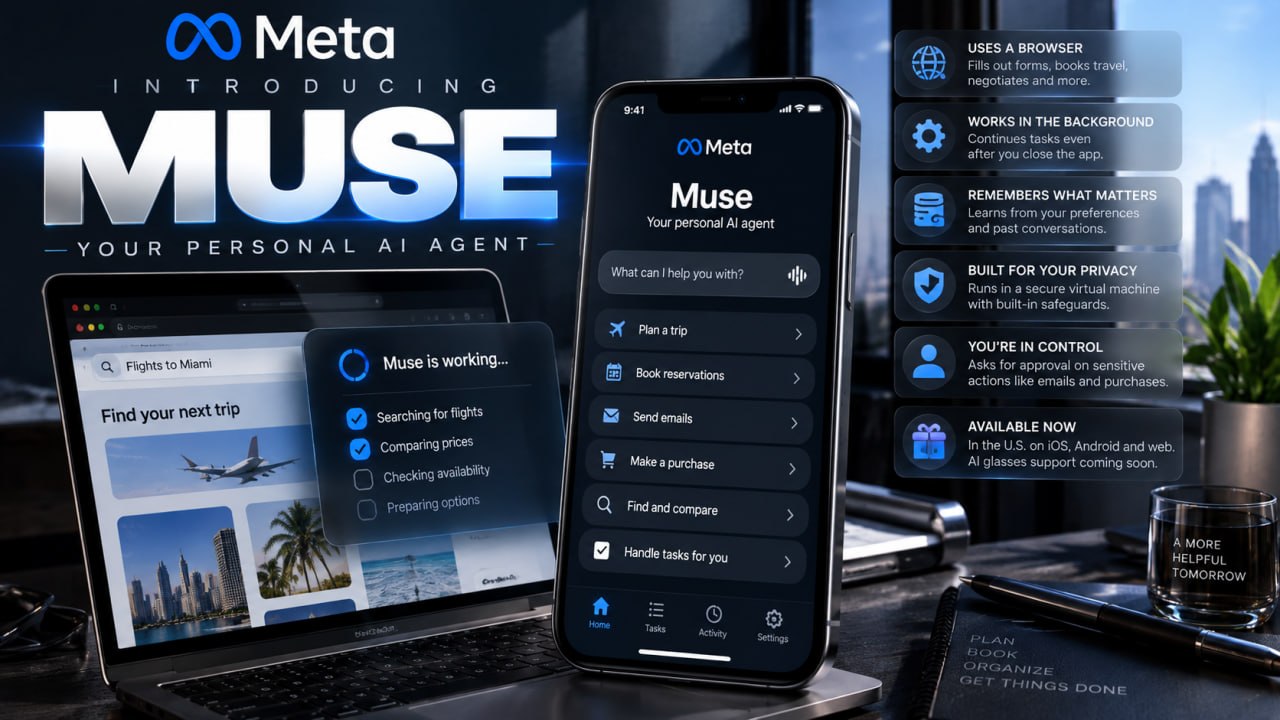
Meta says Muse can open a browser, fill out forms, send emails, book travel and even negotiate on your behalf.
Give it a bigger goal and Muse can help build a personalized plan, coordinate your time and resources, and continue moving the project forward.
AND IT CAN KEEP WORKING AFTER YOU CLOSE THE APP
This might be the craziest part.
For longer tasks, Meta says Muse can continue working even after you leave the app.
Then it'll come back when something changes or when it needs your approval.
For example, Muse is designed to ask before sensitive actions like actually sending an email or making a purchase.
So instead of sitting there babysitting the AI the entire time, the idea is:
Tell it the goal. Let it work. Come back when it needs you.
That's a completely different way of using AI.
IT CAN ACTUALLY REMEMBER YOU TOO
Meta says Muse learns from your conversations and remembers details that matter to you.
Their example is actually pretty wild.
You could save a recipe Reel on Instagram and Muse could turn it into a grocery list, help plan the menu for a dinner party AND remember dietary restrictions your friends mentioned before.
Basically, Meta wants Muse to understand the bigger picture instead of treating every request like a completely separate conversation.
META BUILT A WHOLE COMPUTER FOR IT
Muse runs inside something Meta calls Muse Secure VM.
Think of it like giving your AI its own secure computer in the cloud, including its own browser.
That's where Muse works and where connected information and credentials are securely stored.
There's even a separate system called Sentinel watching what Muse does.
Meta says nothing Muse does reaches the internet unless Sentinel approves it, and the system asks YOU for permission when necessary.
Meta also says Muse can't actually see your passwords or payment information.
You decide which apps it can access and what it's allowed to do inside them.
You can disconnect services whenever you want, and Meta says Muse conversations and VM data aren't shared with its advertising systems.
YES... IT CAN BUY STUFF TOO ?
Muse can use Stripe's Link to checkout online.
Meta says Link creates a one-time-use card so your actual card details stay hidden, and eligible purchases can receive protections for things like damaged or lost items, price drops and returns.
Shop Pay support is coming later, along with 1Password integration.
Again, Muse is supposed to ask for approval before actually making the purchase.
THIS IS WHERE AI HAS BEEN HEADING
We've spent the last few years talking TO AI.
Now these companies want AI that can actually DO things.
Not:
“Here's how you can book your trip.”
But:
“I booked everything and here's what I need you to approve.”
That's a HUGE difference.
Muse is powered by Muse Spark, which Meta calls its most capable model yet for real-world agentic work.
And Meta clearly sees this as only the beginning.
The company says it believes personal superintelligence could become one of the most transformative technologies of our lifetime, with Muse representing an early step toward that future.
Muse is rolling out now in the United States on iOS, Android and the web, with support for AI glasses coming soon.
Meta says most everyday Muse use will be free, while subscription plans will be available for people who want to do more.
AI isn't just trying to become something you talk to anymore.
It's trying to become something you give a job to.